
- Your personal arthrometer
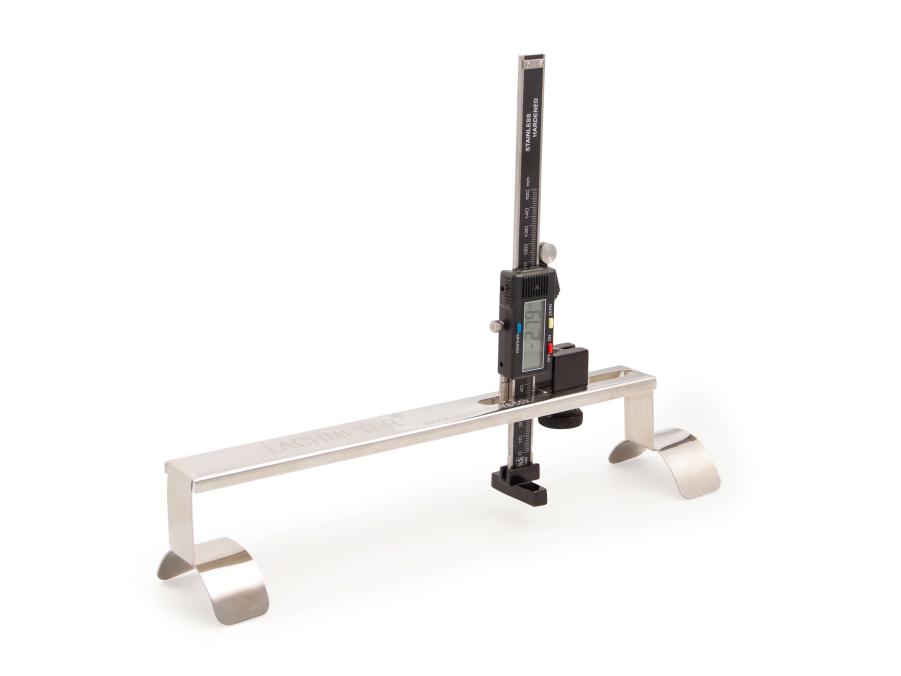
Lachmeter is the digital evolution of the Rolimeter (Aircast), a device that has already proved to be comparable to KT-1000 / KT-2000 (MEDmetric Corp), according to the scientific references below. It’s a lightweight, portable, accurate and easy-to-use arthrometer.
Very useful for pre and post operative evaluations. Decisive in cases where there is doubt between partial or total lesions of the Anterior Cruciate Ligament. Enteded for Orthopedists and Physioterapists.
To be more precise, you don't need heavy equipments.
Lighter than the others
Made of stainless steel to ensure lightness and therefore be easy to carry and handle.
More accurate
Uses high precision digital measurement so you can be more accurate with your results.
Target
Healthcare professionals, such as physiotherapists and orthopedists, who seek more precise results.
Accessories
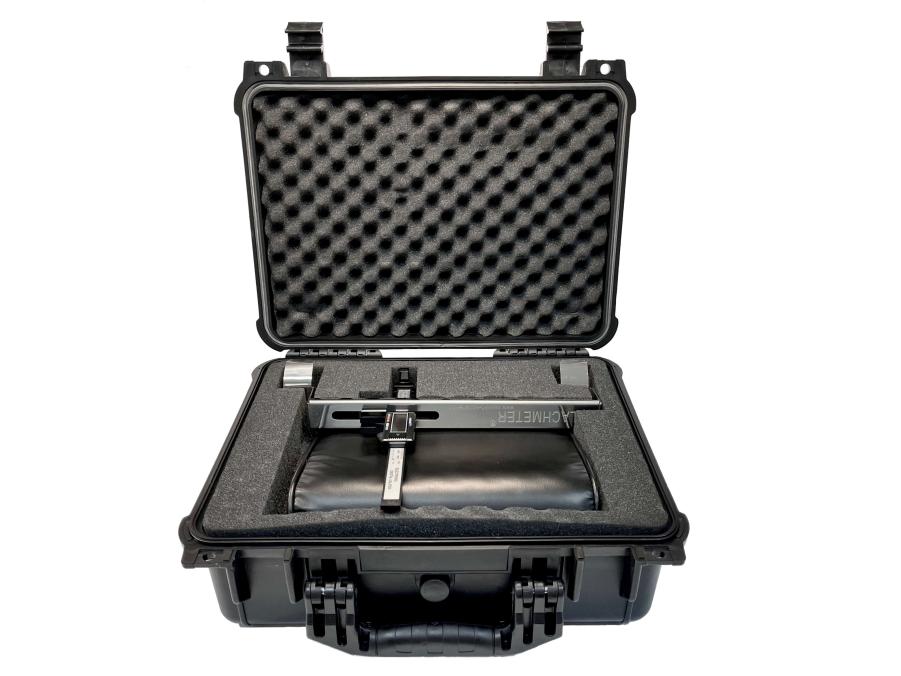
It comes with a cushion to be placed behind the thigh, which facilitates the Lachmeter's use.
Digital
As a digital equipment, the Lachmeter doesn't need to be calibrated.
Trustworthy
Made by and for orthopedists. You can get more accurate results on your pre and postoperative cases.
How it must be used
01
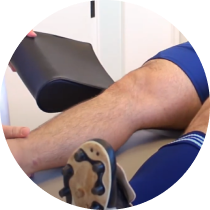
Place the cushion behind the thigh
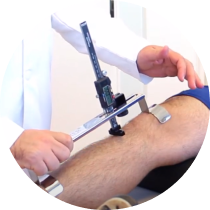
02
Bolster the appliance on the knee
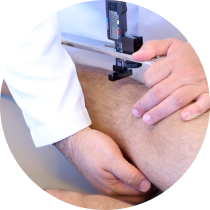
03
Make sure the hamstrings muscles are relaxed
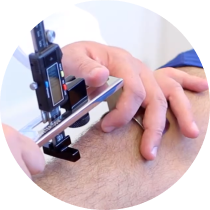
04
Support the stem on the leg and reset the device
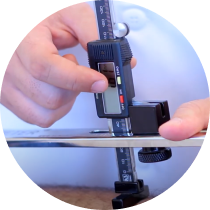
05
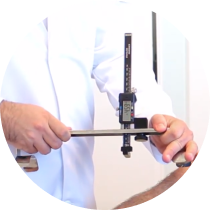
Pull the leg up to its maximum limit, as you would do in the Lachman test
06
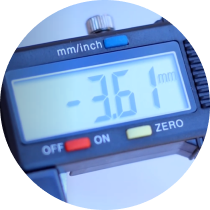
Write down the value and repeat it three times in the same knee
07
Then, compare it with the other side
Assessment
up to
3mm
no ACL injury
between
3 and 4 mm
partial ACL injury*
greater than
4 mm
complete injury
Assessment of laxity | Side-to-side difference
*Without a positive pivot shift test
Scientific References
1. Intra-Tester and Inter-Tester Reliability of the Lachmeter When Measuring Knee Joint Laxity. Mikkel Oxfeldt, Anton B. Pedersen, M. Hansen. Published in Translational Sports Medicine 8 August 2023. Medicine, Engineering DOI:10.1155/2023/5583949Corpus ID: 260758805
2. Daniel DM, Stone ML, Sachs R, Malcom L. Instrumented measurement of anterior knee laxity in patients with acute anterior cruciate ligament disruption. Am J Sports Med 1985;13:401-7.
3. Ganko A1, Engebretsen L, Ozer H. The rolimeter: a new arthrometer compared with the KT-1000. Knee Surg Sports Traumatol Arthrosc. 2000;8(1):36-9.
4. Hughston JC, Andrews JR, Cross MJ, Moschi A. Classification ofknee ligament instabilities. Part I. The medial compartment and cruciate ligaments. J Bone Joint Surg Am 1976;58:159-72.
5. Balasch H1, Schiller M, Friebel H, Hoffmann F. Evaluation of anterior knee joint instability with the Rolimeter. A test in comparison with manual assessment and measuring with the KT-1000 arthrometer.Knee Surg Sports Traumatol Arthrosc. 1999;7(4):204-8.
6. Hemmerich A, van der Merwe W, Batterham M, Vaughan CL. Kneerotational laxity in a randomized comparison of single-versus double-bundle anterior cruciate ligament reconstruction. Am J SportsMed 2011;39:48-56.
7. Papandreou MG1, Antonogiannakis E, Karabalis C, Karliaftis K.Inter-rater reliability of Rolimeter measurements between anteriorcruciate ligament injured and normal contra lateral knees. Knee SurgSports Traumatol Arthrosc. 2005 Oct;13(7):592-7. Epub 2005 Jan 11.
8. Sonnery-Cottet B1, Thaunat M2, Freychet B2, Pupim BH2, MurphyCG2, Claes S3. Outcome of a Combined Anterior Cruciate Ligament and Anterolateral Ligament Reconstruction Technique With a Minimum2-Year Follow-up. Am J Sports Med. 2015 Jul;43(7):1598-605. doi:10.1177/0363546515571571. Epub 2015 Mar 4.
9. Panisset JC1, Ntagiopoulos PG, Saggin PR, Dejour D. A comparisonof Telos™ stress radiography versus Rolimeter™ in the diagnosis of different patterns of anterior cruciate ligament tears. Orthop TraumatolSurg Res. 2012 Nov;98(7):751-8. doi: 10.1016/j.otsr.2012.07.003. Epub 2012Oct 11.
10. Dejour D1, Ntagiopoulos PG, Saggin PR, Panisset JC. The diagnostic value of clinical tests, magnetic resonance imaging, and instrumented laxity in the differentiation of complete versus partial anterior cruciate ligament tears. Arthroscopy. 2013 Mar;29(3):491-9.
11. Mayr HO, Hoell A, Bernstein A, et al. Validation of a measurement device for instrumented quantification of anterior translation androtational assessment of the knee. Arthroscopy 2011;27:1096-104.
12. Pollet V, Barrat D, Meirhaeghe E, Vaes P, Handelberg F. The role ofthe Rolimeter in quantifying knee instability compared to the functional outcome of ACL-reconstructed versus conservatively-treatedknees. Knee Surg Sports Traumatol Arthrosc 2005;13:12-8. doi:10.1016/j.arthro.2012.10.013. Epub 2013 Jan 20
13. Pugh L, Mascarenhas R, Arneja S, Chin PY, Leith JM. Current concepts in instrumented knee-laxity testing. Am J Sports Med 2009;37:199-210.
14. Mayr HO1, Hoell A, Bernstein A, Hube R, Zeiler C, Kalteis T,Suedkamp NP, Stoehr A. Validation of a measurement device for instrumented quantification of anterior translation and rotational assessment of the knee. Arthroscopy. 2011 Aug;27(8):1096-104.
15. Sonnery-Cottet B, Lavoie F, Ogassawara R, Scussiato RG, Kidder JF,Chambat P. Selective anteromedial bundle reconstruction in partialACL tears: a series of 36 patients with mean 24 months follow-up. KneeSurg Sports Traumatol Arthrosc 2010;18:47-51.
16. Richard Norris, Alan Price, Thomas W. Maddox, William Boswell, Cronan Kerin Journal: Journal of Experimental Orthopaedics (JEO) – Official journal of the European Society of Sports Traumatology, Knee Surgery & Arthroscopy (ESSKA) Year: 2025 DOI: 10.1002/jeo2.70251
Testimonials
See what our costumers think about the new arthrometer and garantee your expectations fufilled.
accurate data for clinical and research purposes."


WE SHIP WORLDWIDE
Contact Us
- +55 16 98177-1166
- @knee_arthrometer
- sales@lachmeter.com